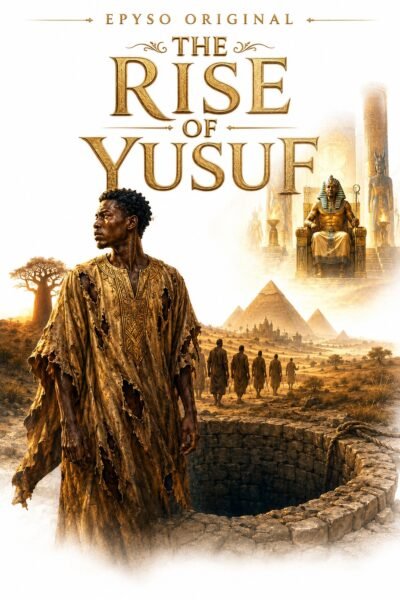
In the ancient city of Kano, where the harmattan winds carried whispers of destiny across the dusty streets, lived a man named Ibrahim. He was not just any man – he was a wealthy cattle trader whose herds stretched as far as the eye could see. His compound was the size of a small village, with mud walls painted in beautiful patterns and a large baobab tree at its center where the family gathered each evening.
Ibrahim had twelve sons, but among them all, one boy shone like a diamond in the sand. His name was Yusuf, the second youngest, born to Ibrahim’s most beloved wife, Rahila. Yusuf was seventeen years old, tall and handsome with eyes that seemed to hold the wisdom of the elders, even though he was still young.
Now, you must understand something about Nigerian families – when a father loves one child more than the others, trouble is never far behind. It’s like pouring palm oil on fire. Ibrahim’s love for Yusuf was obvious to everyone. While his other sons wore simple cotton clothes, Yusuf walked around in a magnificent agbada made from the finest cloth, with golden threads woven through it. The robe was so beautiful that people would stop on the street just to admire it.
“See this boy,” the women in the market would whisper. “His father treats him like a king’s son.”
But Yusuf’s brothers saw this differently. Their hearts grew bitter like kola nut left too long in the sun. Every time they saw their father’s eyes light up when Yusuf entered the room, jealousy ate at them like termites eating wood.
The real trouble started the morning Yusuf came running to his father with excitement dancing in his eyes.
“Baba! Baba!” he called out, using the respectful term for father. “I had the most amazing dream!”
Ibrahim was sitting under the baobab tree, sipping his morning tea. He smiled at his beloved son. “Tell me about this dream, my son.”
Yusuf sat cross-legged on the mat beside his father. “I saw eleven stars and the sun and the moon, and they all bowed down to me!”
The other brothers, who were nearby preparing for the day’s work, stopped what they were doing. Their faces darkened like storm clouds.
Ibrahim’s eyes widened. He knew about dreams – in their culture, dreams were messages from Allah. This dream meant something big. “My son,” he said quietly, “do not tell this dream to your brothers. Keep it to yourself.”
But it was too late. The brothers had heard enough.
That evening, as the family sat around sharing their meal of rice and stew, the tension was thick like humid air before a rainstorm. The older brothers – Ruben, Simon, Levi, and the others – exchanged meaningful looks. They ate in silence, but their minds were busy like busy bees.
After dinner, when Yusuf had gone to his room, the brothers gathered in secret.
“Did you hear what that boy said?” hissed Judah, his voice low and angry. “The sun, moon, and stars bowing to him? He thinks he’s better than all of us!”
“Our father has spoiled him rotten,” added Simon, spitting into the dust. “That expensive agbada, the special treatment – and now he thinks he’s going to rule over us?”
Levi, the hot-tempered one, clenched his fists. “Something must be done about this boy. He’s becoming too proud.”
The brothers nodded in agreement. In their hearts, a dangerous seed had been planted – the seed of hatred.
Days passed, and Yusuf continued to have dreams. He was young and innocent, not understanding that sometimes it’s better to keep certain things to yourself. One morning, he shared another dream with his brothers.
“I dreamed that we were all in the field tying bundles of grain,” Yusuf said excitedly. “My bundle stood up straight, and all of yours bowed down to mine!”
The silence that followed was deafening. You could hear a pin drop.
“So,” said Ruben slowly, his voice dangerous, “you think you’re going to rule over us? You think we’re going to bow to you like servants?”
“I… I was just sharing my dream,” Yusuf stammered, finally sensing the anger in the air.
“Keep your dreams to yourself,” growled Levi.
From that day forward, the brothers could barely stand to look at Yusuf. When he walked into a room, they would turn their backs. When he tried to join their conversations, they would walk away. The family compound, which had once been filled with laughter and unity, became divided like a house with a crack in its foundation.
Ibrahim noticed the tension but hoped it would pass. He had no idea that his sons were planning something terrible.
Lesson from Episode 1: Sometimes the gifts that make us special can also make us targets. Yusuf’s dreams were a blessing, but sharing them at the wrong time and with the wrong people brought him trouble. Wisdom is not just about having knowledge or gifts – it’s about knowing when and how to use them. Also, favoritism in families can destroy relationships and breed jealousy that lasts for generations.
Reading settings
Made for how you read. Saved on this device.
0 Comments — Be the first to share your thoughts!
No comments yet. Be the first to leave one!